
A US nonprofit policy think tank, the Federation of American Scientists (FAS), estimates India's nuclear arsenal at 190 warheads, including those for new missiles under production. The report highlights India's ongoing modernisation of its nuclear capabilities and adherence to a no-first-use doctrine, while also noting uncertainties in warhead designs and plutonium reserves.

India is increasingly focusing on long-range weapons capable of reaching targets across China.

A new report from the Stockholm International Peace Research Institute (SIPRI) indicates that India has expanded its nuclear arsenal and is developing long-range weapons capable of reaching targets across China, while also maintaining focus on its rivalry with Pakistan.

Primarily aimed at India, Pakistan is making qualitative and quantitative improvements to its nuclear arsenal and "could increase the number of circumstances under which it would be willing to use nuclear weapons," a Congressional report has said.
"Obviously, these are two nuclear powers. Whenever you are dealing with terrorism in countries that are nuclear powers, it is always -- it creates a heightened concern. Obviously, the Pakistani government has enormous challenges -- financially, politically, from terrorists," US Defence Department Spokesman Geoff Morrell said. "We see no reason at this point to have any concern with regards to the security of either country's arsenal," he added.

Obama seeks reduction of nuclear arsenal in India and Pakistan while Pakistan seeks NSG membership

India and Pakistan are reportedly expanding their nuclear arsenal, despite a global trend towards disarmament, the Stockholm International Peace Research Institute has said.
"The ultimate aim should be to have at least four such submarines so that at least one, if not two, are on patrol duty at all times," said Padmanabhan.
'China is in the middle of a substantial expansion of its nuclear weapon arsenal, which satellite images indicate includes the construction of over 300 new missile silos,' SIPRI's statement noted.

M R Srinivasan focused on the peaceful use of nuclear power at a time when the popular view among the 'hawks' was that India should build a nuclear arsenal as a deterrent.

Pakistan's nuclear arsenal is 'simply a deterrent' to protect the country and there will no longer be any need for it once the Kashmir issue is resolved, Prime Minister Imran Khan has said as he asserted that if the Americans have the resolve and the will, the issue can be sorted out.

Newly declassified documents from the United States National Security Archive have revealed that Pakistan's nuclear proliferation was a significant concern for both the US and Russia, with leaders expressing 'nervous' fears about the country's atomic stability.

'DRDO has been directed to license missile technologies to the private sector.'

It is an unusual choice to depute a retired general for the funeral of a revered religious figure but a thoughtful one in an attempt to inject verve into the bilateral relationship and restore the equilibrium in India's West Asian policies, notes Ambassador M K Bhadrakumar.

A lesson for India is to clearly define objectives beforehand, so that the adversary or other parties do not attempt to mitigate them midway.

Nearly all of the nine nuclear-armed States, including India and Pakistan, continued intensive nuclear modernisation programmes in 2024, upgrading existing weapons and adding newer versions, according to a report by a global think-tank.

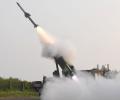
Like the Shourya and Prahar missiles, the Pralay is powered by conventional solid fuel, and its payload is designed to carry only a conventional warhead.

'As result, Netanyahu 'convinced' Trump to go to war with the help of overoptimistic Israeli intelligence assessments, essentially explaining to him that they only need to bomb Iran for 3-4 days, and the regime would then collapse.' 'Rather unsurprisingly, Netanyahu is ever since blaming his own intel service for the entire operation failing.'

The report put India's 'stored' nuclear warheads at 172 in January this year while the number for Pakistan was 170.

'Pakistan's is the only military-controlled nuclear weapons programme in the world.' 'As people get radicalised, the risk of a brigadier or pilot taking matters into their own hands is a real concern.'

If Trump wants peace with Iran, Pakistan will offer to help. If Trump seeks Pakistan's aid to spy on Iran, then too Munir will not hesitate to chip in. At the same time, the ISI will not hesitate to tip off Iran now and then, points out M R Narayan Swamy.

Odisha-based BonV Aero has partnered with ParaZero Technologies to introduce advanced counter-drone systems to India's defence and security agencies, offering a kinetic solution to neutralise hostile drones.

The intriguing bit is that Trump is likely to attend the talks in Islamabad this weekend -- if he does, it will be the clearest signal yet that the US is ready to exit the war with some sort of win to show, since he cannot afford to go for the talks and return empty-handed, notes Prem Panicker in his must read blog on the Iran War

China will be the nuclear threat of most concern to New Delhi for at least another decade, the latest report by the Arms Control Association says.
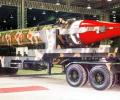
The US intelligence assessment highlights Pakistan's near-certain procurement of weapons of mass destruction-applicable goods from foreign suppliers, primarily through Chinese support.

'The United States loves working with dictators' 'Because then you don't have to worry about public opinion and you don't have to worry about the media anymore'

'What we need to watch is how Saudi Arabia's financial assistance will be used by Pakistan. If the funds go to build their military hardware and operations, it should worry us.'

The question is no longer whether the war will expand. It has. The next few days will tell us whether the war stabilises around Hormuz or whether the Strait itself becomes the trigger for a far larger rupture. What to watch for over the next 48 hours is simple: Any move by the US toward direct naval control of the Strait; any credible Iranian attempt to disrupt or mine shipping lanes and, critically, whether energy infrastructure in the Gulf continues to be targeted.If those lines are crossed in tandem, the war will no longer be containable within the region.

In its 28-page report, the CRS noted that Pakistan's nuclear arsenal is widely regarded as designed to dissuade India from taking military action against it, but Islamabad's expansion of its nuclear arsenal, development of new types of nuclear weapons and adoption of a doctrine called "full spectrum deterrence" have led some observers to express concern about an increased risk of nuclear conflict between Pakistan and India, which also continues to expand its nuclear arsenal.
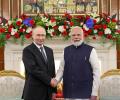
Luckily for us, a Russia that is desperate to stay relevant in an emerging multipolar world finds in India a reliable geostrategic partner. The Russian proximity to India also keeps China from exploiting its economic dominance vis a vis Russia, points out Colonel Anil A Athale (retd).

Trump has made it clear: the US will not lift its blockade of Iranian ports until a deal is signed.

Abbasi was also assertive of Pakistan's nuclear arsenals being safe and secure.

The 'rescue' operation occurred within kilometres of Iran's underground tunnel complex at Isfahan, assessed by the IAEA and US intelligence as holding a substantial portion of the country's 60 per cent enriched uranium stockpile. Retired senior US military officers have highlighted that the mission's footprint -- hundreds of special operators, multiple heavy-lift aircraft deep inside Iran -- appears outsized for recovering a single airman. Prem Panicker continues his must read blog on the Iran War.

Russia, being bogged down by the Ukraine war and prioritising the requirements of its own armed forces, along with India's consistent diversification policy, will remain a major challenge to the bilateral partnership, note Harsh V Pant and Aleksei Zakharov.

'Only when India's adversaries are convinced that India has both the necessary political and military will and the hardware to respond to a nuclear strike with punitive retaliation that will inflict unacceptable loss of human life and unprecedented material damage, will they be deterred,' says Brigadier Gurmeet Kanwal (retd).

'Within 30 minutes of when Asim Munir made those comments, he should have been taken to Tampa airport and flown out of the United States.'

The delegations from the US and Iran head to Islamabad on Friday, carrying a ceasefire that is already fraying, a Strait that is technically open and practically closed, and a negotiating agenda that would challenge even parties actually negotiating in good faith, which these groups are not. Prem Panicker continues his must read blog on the Iran War.
Pakistan is making qualitative and quantitative improvements to its nuclear arsenal, which is primarily targeted towards India, and could increase the number of circumstances under which it would be willing to use atomic weapons, according to a US Congressional report.

The purge in Washington does not pause the war. Strikes continue, Hormuz remains closed, and Brent crude is still dancing around $109 a barrel. For India, the command chaos in the Pentagon is another layer of uncertainty piled on five weeks of conflict that was already straining every buffer Delhi has.

I am inclined to believe that the Venezuela adventure is not an indication of American strength, alas, but rather of American weakness, points out Rajeev Srinivasan.
